IB Tutoring Academy
MYP grading

MYP Grading Explained: Criteria, Levels and Feedback

MYP grading can feel unfamiliar when reports talk about criteria and achievement levels instead of percentages. This page explains how MYP grading works, how to read feedback, and how to plan MYP5 revision, the Personal Project and the move to DP or CP.

Read the FAQs
MYP Grading Explained: Criteria, Levels and Feedback

What MYP grading actually measures

MYP grading is a judgement of what a student can show against published criteria, rather than a simple average of marks added together. Teachers read a piece of work, compare it with the descriptors for each criterion, and decide which description fits best. This is why effort alone does not decide the level, and why a report may look quite different from the percentages many families remember from other school systems.

For parents, this often means needing a translation. A report may list achievement levels for several criteria in each subject, and it is not always obvious what a level says about the student's strengths. A useful first step is to ask what the descriptor actually requires, then compare it with the task the student handed in. Once that link is clear, the report becomes much easier to discuss at home.

Understanding Criteria A to D

In MYP subjects, work is assessed through separate criteria labelled A to D. Each criterion looks at a different part of what the student is expected to do, and the focus changes from one subject to another. Because the criteria are separate, a student can be confident in one and still find another difficult. A strong grasp of content, for example, does not automatically mean a clear, well-organised written explanation.

Not every subject works the same way, so it is worth checking the subject guide and the teacher's task-specific descriptors instead of assuming. The wording of one criterion in a subject may ask for something quite different from the same letter in another subject. Students who read the descriptors before starting a task, and again before handing it in, are more likely to notice gaps early and can ask their teacher sharper, more useful questions.

🧩

Each criterion judges a different kind of skill

⚖️

Strength in one criterion does not guarantee strength in another

🔤

Subjects can word the same letter differently

📘

Read descriptors before starting and before submitting

From achievement levels to an overall subject grade

Within each criterion, a piece of work receives an achievement level. The school then combines the levels from different criteria and tasks into an overall judgement for the subject. The exact method is decided by the school and described in its assessment policy, so this page does not offer boundaries or fixed conversions. Treating any online table as final could lead a student to misread their own report.

Families should confirm the details in the school's assessment policy or by asking the subject teacher. Useful questions include which tasks count towards the overall judgement, whether later work is treated differently from earlier work, and how the school handles a criterion that has been assessed several times. Writing the answers down gives students a clear picture of where careful effort will matter most as the year goes on.

Schools combine criterion levels into an overall judgementThe exact process is set in the school's policyAvoid relying on unofficial conversion tablesAsk teachers which tasks count towards the overall judgement

How to read feedback and spot recurring weaknesses

Achievement-level feedback is most useful when it is read across several units instead of one task at a time. Put the criteria in a simple table, add the level and the teacher's comment from each summative task, and look for repeats. If the same criterion slips again and again, that is a pattern worth working on directly, whatever the subject content happened to be in each unit.

Then turn the comments into a short list of next steps. Choose a few recurring points and rewrite each as an action, such as adding a clearer explanation of method or checking the task descriptor before submitting. Attach each action to the next task. A short, specific list is easier to follow than a long one, and it gives a tutor or teacher something concrete to review together with the student.

How to read feedback and spot recurring weaknesses - myp grading
  1. Record levels and comments from every summative task
  2. Look for the same criterion slipping repeatedly
  3. Turn comments into actions, not general worries
  4. Keep the next-step list short and specific

Common misunderstandings and challenges with MYP grading

One common frustration is the gap between effort and achievement. A student may work for many hours and still receive a level that feels lower than expected. The criteria judge what the finished work shows, so time spent matters only when it changes the quality of what is submitted. Talking through the descriptor with the teacher helps separate effort that was well directed from effort that missed the target.

Another puzzle is the draft that looks good but still loses marks on a criterion. Neat presentation or a long answer may not address what the descriptor asks for, such as explaining reasoning or using evidence clearly. Large tasks add a further challenge: when they feel overwhelming, students often avoid them. Breaking a task into small, dated steps usually makes the first move easier, and it keeps the work from piling up.

Where MYP grading gets confusing

  • Effort matters, but the level reflects the finished work
  • A polished draft can still miss a descriptor
  • Long answers do not always meet the criterion

What helps

  • Small dated steps make large tasks less daunting

MYP5 in November: when everything feels important at once

List each demand separately to reduce the sense of overload

For many MYP5 students, November is the moment when everything seems to matter together: summative tasks, Personal Project work, future subject choices and, in some schools, eAssessment preparation. That pressure is understandable.

Large tasks can feel overwhelming

Large tasks may start to be avoided because they feel overwhelming, and the longer they wait, the heavier they feel. Naming each demand separately is often the first way to make the list manageable.

Start cumulative revision from earlier units

November is a sensible point to begin more cumulative revision while keeping the Personal Project moving towards completion.

Use achievement-level feedback to choose what to revise

Students can revisit earlier units and use their achievement-level feedback to identify recurring weaknesses, instead of revising every topic equally.

Check what each DP or CP subject involves

DP or CP subject choices may also need confirming around now, so students should understand what each chosen subject involves and how it fits their academic profile and future plans.

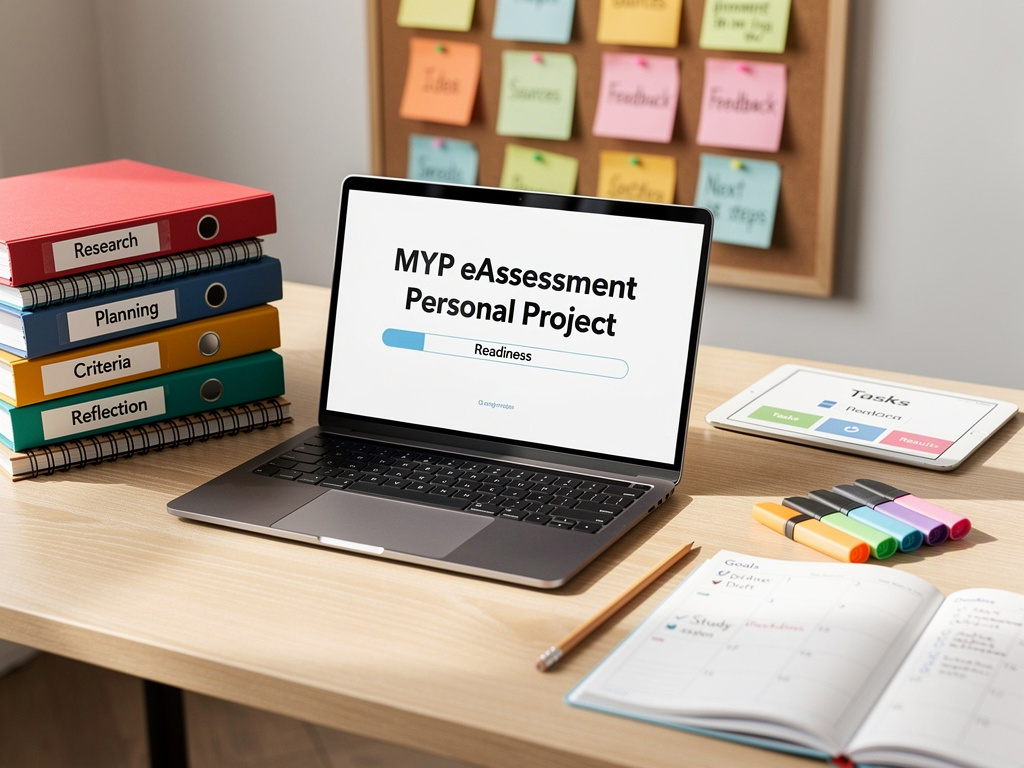
Personal Project and eAssessment readiness

Personal Project and eAssessment readiness - myp grading
1

Report, product or outcome, and documentation all matter

The Personal Project is also judged against criteria, so the report, the product or outcome, and the documentation all need to show the student's thinking clearly. Depending on the school timeline, students may begin drafting or planning the report around this time.

2

Keep notes, sources and reflections organised as you go

Keeping notes, sources and reflections organised along the way makes the final writing far less stressful than reconstructing the process at the end.

3

Not every school takes part in eAssessment

Where a school takes part in MYP eAssessment, students may also begin more structured preparation for ePortfolio requirements and on-screen examinations.

4

Confirm timelines with the coordinator or subject teacher

Not every school follows the same pattern, so the most reliable step is to check the school's own timeline and ask the coordinator or teacher what applies. Knowing the dates and requirements early helps students fit this preparation around summatives instead of meeting it all at once.

Using the winter break to close gaps before the final semester

December can be used to close academic gaps before the final MYP5 semester. A realistic plan starts by reviewing the weaker criteria in each subject, using the feedback gathered so far. Schools may hold semester assessments, and Personal Project deadlines may be approaching, so students should check what is still unfinished, such as bibliography work, documentation or sections of the report, and put those items on a short list.

Personal Project deadlines can make it hard to switch off during the break, and work that is postponed may return in January alongside mock pressure. A clear plan reduces that risk by deciding in advance what will be done and what can wait. Students who have largely decided on their next programme can also begin learning what DP or CP will expect, with the aim of understanding the transition rather than starting future coursework early.

How online tutoring can support MYP learners and how to get started

IB Tutoring Academy offers online IB tutoring from experienced subject tutors. For MYP learners, that support can focus on decoding criteria and descriptors, planning revision from achievement-level feedback, and keeping large projects such as the Personal Project moving in manageable steps. The aim is to help the student understand what each criterion asks for, so that future work is shaped by that understanding.

To get started, use the consultation form on the site. It is the way to share which subjects, criteria or deadlines are causing the most concern, so the conversation can begin from the student's real situation. Bringing recent reports, teacher comments and the school's timeline for the Personal Project or eAssessment makes that first conversation more practical and focused.

  1. Decode criteria and descriptors with a subject tutor
  2. Plan revision directly from achievement-level feedback
  3. Keep large projects moving in manageable steps
  4. Start through the consultation form on the site

Frequently asked questions about MYP grading

What is MYP grading?

MYP grading is a judgement of a student's work against published criteria, with achievement levels given for each criterion. It is different from adding up marks into a percentage. Teachers compare the work with descriptors and decide which level fits best, and the school then combines those judgements into an overall view of the subject.

Why can a student do well in one criterion and struggle in another?

Each criterion assesses a different kind of skill, so strength in one area does not automatically carry over to another. A student may understand content well but find it harder to communicate or organise ideas clearly. Checking the subject guide and teacher descriptors shows what each criterion expects, which helps students focus practice where it is needed.

How does my school turn achievement levels into an overall grade?

The method is set by the school and explained in its assessment policy, so it is best to confirm it there or with the subject teacher. Ask which tasks count, how different criteria are combined, and whether later work is treated differently. Avoid relying on unofficial conversion tables, because they may not match your school's process.

When should MYP5 students begin cumulative revision?

November is a sensible point to begin more cumulative revision, because students can revisit earlier units and use achievement-level feedback to find recurring weaknesses. It also gives time to keep the Personal Project moving. The right pace still depends on the school timeline, so students should check upcoming summatives and deadlines before planning.

Can online tutoring help with the Personal Project and MYP criteria?

Online tutoring can help students understand criteria, plan revision from feedback and break large projects such as the Personal Project into manageable steps. It does not replace the school's own guidance, so students should keep following their teacher and coordinator. To begin, families can use the consultation form on the IB Tutoring Academy site.

Talk through MYP grading with a subject tutor

If MYP criteria, feedback or the Personal Project feel hard to untangle, use the consultation form on our site to get started with online IB tutoring.