Find the gaps through discussion and recent work
A good lesson begins with diagnosis. The tutor looks at recent work or asks the student to talk through a problem, which shows where understanding is solid and where it is thin.
Looking for an IB chemistry tutor in Gurgaon? IB Tutoring Academy offers online IB tutoring from experienced subject tutors, so Chemistry SL and HL students can work one to one from home. Here is how the support works and how to begin.

IB Chemistry asks students to hold abstract ideas in mind, such as particles, energy changes and reaction mechanisms, while also doing careful quantitative work. Many students follow an idea when it is explained in class, then find it slips away when they meet an unfamiliar question alone. The content is substantial, and units build on one another, so a small gap in early understanding can quietly cause trouble later in the course.
One-to-one tutoring tends to make sense when a student keeps getting stuck on the same kind of question, when calculations feel like guesswork, or when revision feels like rereading notes without real progress. A tutor can slow down, ask questions to find where the understanding breaks, and explain the idea in a different way. It is not a replacement for effort, but it can make that effort more focused and less stressful.
IB Tutoring Academy teaches online, so a student in Gurgaon can work with a subject tutor from home. In practice, that means a screen, a stable connection and a shared workspace where the tutor and student can write out equations, sketch structures and work through problems together as they would on a whiteboard.
It helps to have school notes, the class textbook, a calculator and any recent homework close at hand. Students can show the tutor exactly what they were given in class, and the tutor can respond to that material directly. Because lessons are online, there is no travel involved, which leaves more of the student's energy for the chemistry itself.
Students often arrive with a particular unit in mind. Atomic structure and bonding are common starting points, because so much later work depends on them. Energetics and kinetics bring in calculations and graphs, and equilibrium asks students to reason about how a system responds to change. A tutor can unpack each of these step by step, linking the particle-level picture to the numbers on the page.
Acids and bases, redox and organic chemistry are also frequent requests. Organic chemistry, for example, can feel like a long list of reactions until a tutor shows the patterns that connect them. Redox becomes more manageable once the idea of electron transfer is clear. In each case, the focus is on understanding why something happens, so that recall comes more naturally.
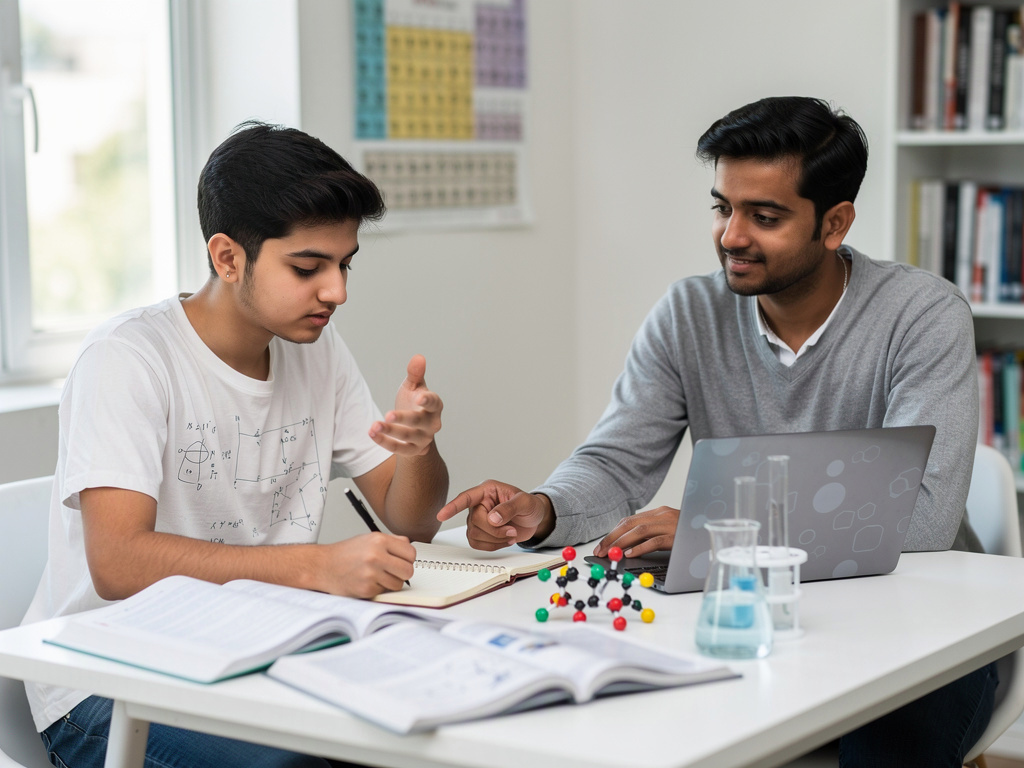
A good lesson begins with diagnosis. The tutor looks at recent work or asks the student to talk through a problem, which shows where understanding is solid and where it is thin.
From there, the tutor rebuilds the weaker ideas from the ground up, using plain language and diagrams before moving to formal definitions and notation.
Worked examples come next, with the tutor showing how to think as well as what to write.
The student then attempts similar questions with guidance, gradually taking over more of the reasoning.
The lesson closes with a short review of what was covered and what to revisit, so the next session can pick up cleanly. This follows the method theme described across the academy's site: understand, practise, review.
The chemistry internal assessment can feel open-ended, which is exactly why many students want a sounding board. A tutor can help a student think through what makes a research question focused and testable, how to plan a method that can actually produce usable data, and what to consider when handling measurements and uncertainty. These are conversations about thinking, not about doing the work for the student.
When it comes to writing up, a tutor can explain what clear scientific communication looks like: a logical structure, careful treatment of data, and honest evaluation of limitations. The investigation, the data and the writing must remain the student's own. The tutor's role is to ask good questions, point out where an argument is unclear, and help the student improve their own understanding and judgement.
Knowing the chemistry is only part of an exam. Students also need to read command terms carefully, because an answer to describe, explain or evaluate is built differently in each case. A tutor can show how to match the depth and shape of an answer to the wording of the question, and how to avoid common slips such as answering a slightly different question from the one asked.
Practice questions are used to build confidence and to spot patterns. Together, student and tutor look at how to set out a calculation, show working clearly so marks can be earned for method, and read data-based questions without panicking. Mistakes are treated as useful information: reviewing why an error happened often teaches more than a correct answer. No particular grade is implied, but the habits learned here tend to make revision calmer.

The next step is simple: use the consultation form on the IB Tutoring Academy site. Tell us whether the student is taking Chemistry SL or HL, what feels most difficult right now, and what the school has coming up, such as a unit test, a practical write-up or mock exams. The more specific you are, the easier it is to think about how support could be shaped.
It is worth being realistic about what to expect. The form is a way to start the conversation, and it does not by itself set out details such as availability or arrangements. Those are things to ask about directly. If you are unsure whether tutoring is the right step, say so on the form and explain what you are noticing; that is a perfectly good place to begin.
Yes. IB Tutoring Academy teaches online, so a student in Gurgaon can work with a subject tutor from home. You will need a screen and a stable connection, and it helps to keep school notes, a calculator and recent tasks nearby so the tutor can work with your actual material.
Tutoring can be shaped around either level. The tutor adjusts the pace, the depth of explanation and the kind of practice to suit what the student needs. If you are looking for an IB chemistry SL tutor or HL support, mention the level on the consultation form.
No. The investigation, data and write-up must remain the student's own work. A tutor can help you think about a research question, plan a method, treat data and uncertainty, and communicate clearly, but the decisions and writing are yours.
Use the consultation form on the site. Share the student's level, what feels difficult in Chemistry and any upcoming school demands. The form begins the conversation, and you can ask there about any practical details you want to understand before going further.
Tell us whether the student takes Chemistry SL or HL, what feels hard right now, and what is coming up at school. We will take it from there.